Virtual hospital and ward tours
Orientation for students and new staff: wards, intensive care, theatres and equipment, explored before the first clinical posting.
 8xwork
Healthcare · VR & AR development
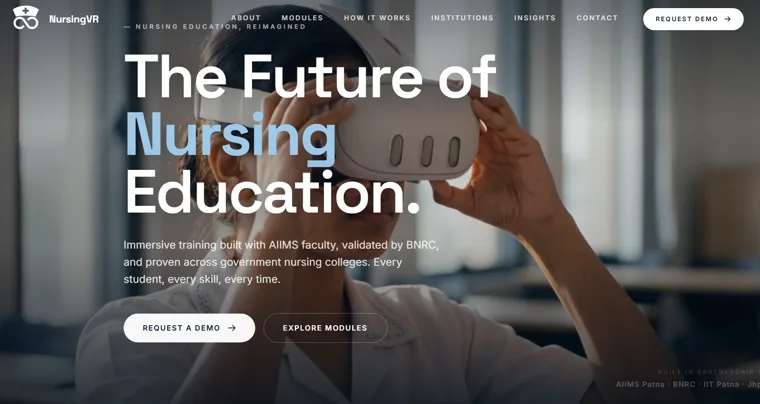
We build virtual reality training for nursing colleges, hospitals and healthcare educators: clinical spaces students can walk through, procedures they can rehearse step by step, and content your own faculty review. NursingVR, from our portfolio, works this way, with clinical content co-designed with AIIMS faculty.
What we build
Orientation for students and new staff: wards, intensive care, theatres and equipment, explored before the first clinical posting.
Step-by-step practice of a defined procedure, with prompts and feedback at the moments your faculty choose.
Checks built into the exercise and records instructors can review, so practice connects to your curriculum.
Session control, content access and reporting for the people running the training programme.
Experiences that run without a gaming PC, and offline where connectivity in the training room is limited.
Android and web tools for learners, families or care teams, as in Sound for Silence, where the programme needs more than VR.
Why it works
Students need to understand clinical spaces and procedures before they practise in the real setting. A virtual environment lets them look around a ward, find the equipment and rehearse a sequence first.
A scenario can be repeated as often as a learner needs, run the same way for every student and paused for explanation. Situations that are rare or risky in a real hospital can be practised without risk to anyone.
From our portfolio
Healthcare · Immersive learning
Interactive VR for nursing education, with clinical content co-designed with AIIMS faculty.
View project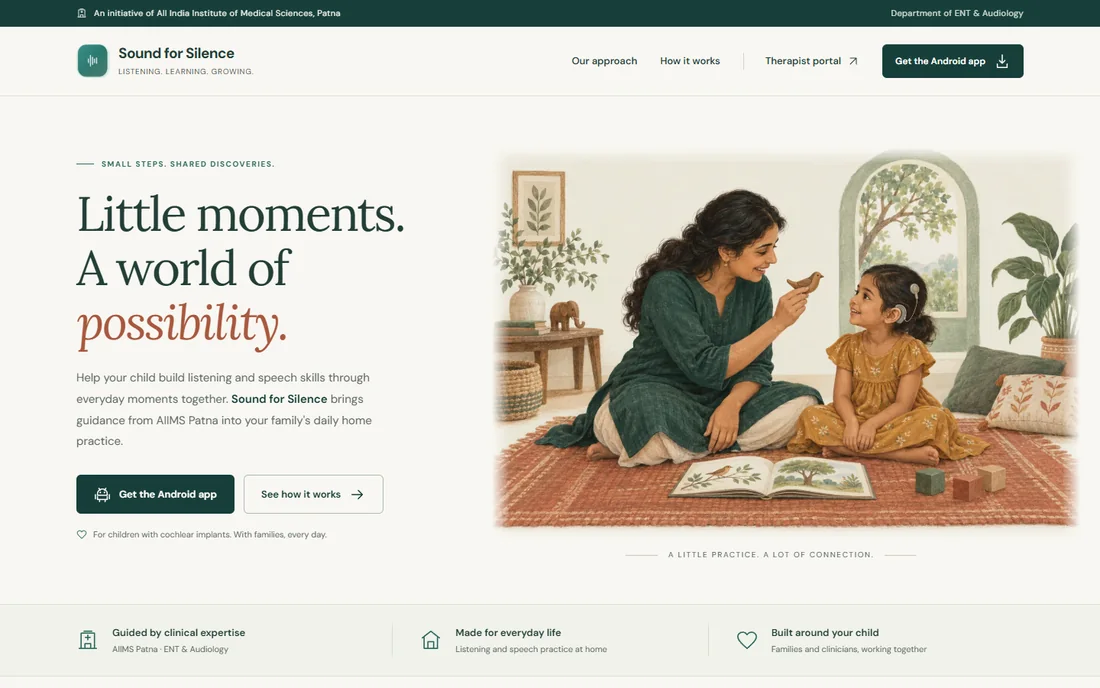
Healthcare · Software platform
Android and web tools for an AIIMS auditory verbal therapy initiative, connecting families, therapists and hospital teams.
View projectHow a project runs
Map the users, current process and intended result. Prioritise the first release and identify dependencies, budget and decision-makers.
You review: the scope & acceptance criteria.
Review the important decisions through a prototype, storyboard or technical plan. Resolve the largest unknowns before full production.
You review: a prototype, plan or sample.
See working releases at agreed milestones. Check complete journeys and record feedback against the approved requirements.
You review: working milestones & test results.
Complete acceptance checks and the agreed documentation, access and training. Confirm who owns operation, maintenance and the next release.
You review: the release & handover pack.
Scope and cost
Questions
Yes. Your authorised clinical experts define and approve the procedures, terminology and assessment. We build the environment and interactions around their decisions and agree the review rounds in the plan. NursingVR’s clinical content was co-designed with AIIMS faculty.
We usually build for standalone headsets, so a training room does not need gaming PCs, and we can design for offline use. The right device depends on your scenario, budget and how many learners train at once, so we agree it while scoping the project.
Yes, and we recommend it. A single scenario lets your faculty and learners review the approach before you commission more modules.
NursingVR offers training modules for nursing institutions; visit nursingvr.in for its current programme. 8xWork builds custom VR training around your own procedures, environments and curriculum.
Custom engagements start at ₹5 lakh. The final cost depends on the scope you choose: how much is built in the first release, the review process, devices or integrations, and support after launch. International proposals are issued in USD.
Start a project
Bring the problem, the intended users and your priorities. We’ll discuss the scope, budget and next step. A finished specification is optional.